Boston Sports Medicine and Performance Group, LLC Blog

Caught In The Middle

Posted by Boston Sports Medicine and Performance Group on Tue, Oct 12, 2010 @ 07:10 AM

everything basketball


This past week a good strength coach friend of mine from a major BCS school called me complaining about the Athletic Trainer that cared for the team that she coordinated the performance training for asking me if I thought teaching and training a body weight squat was contraindicated in an athlete’s progression back to sport after ankle surgery.  Apparently the athletic trainer told her that the athlete was not to do ANY lower extremity work in the weight room, even though she was weight bearing without crutches and performing about 100 heel raises daily in her rehab plan. 

I told her I didn't think so but then asked her if she had ever put on an in-service for the athletic trainers on what exercises and progressions they used in the weight room to safely return athletes back to activity.

…. Long pause….. “But that’s not my job.”

A few days later an old athletic trainer friend emailed me asking me how many female soccer athletes we had with stress fractures this season. I told him none and he went off about how the strength coach at his institution “just didn’t get it and was causing all the stress fractures.” I asked him if he evaluated the soccer team for hip and ankle dysfunction prior to the year to see if they were “qualified” to do take on the training program.

….. long pause…… “But that’s not my job.”

If it’s not your job, then whose job is it?

Unfortunately, when we make it someone else’s job and fail to make the initial investment needed to help our athletes we only end up making more work for ourselves.  You may 'lose' the argument with the athletic trainer or strength coach that day, but the only one that really ends up losing is the athlete stuck in the middle.


Art Horne is the Coordinator of Care and Strength & Conditioning Coach for the Men’s Basketball Team at Northeastern University, Boston MA.  He can be reached at a.horne@neu.edu.

Topics: Art Horne, Strength Training, athletic training, Health

The Puke Bucket

Posted by Boston Sports Medicine and Performance Group on Mon, Oct 11, 2010 @ 07:10 AM

everything basketball
“Do you know what all those names on that bucket mean?”

“Um, no I’m not sure. What?”

“Each name is a kid that puked during one of our training sessions. Isn’t that awesome?  See the one that has the number four scratched off and a five put beside it? He really blew some chunks!  I let them sign it after they puke.”

(The above is an actual conversation from a “performance coach” at a “sports performance” center just outside Boston )

Now accepting your child for only $600 for an eight week session!

When did squat, clean and puking become the standard for which we measure success?

What’s next, bicep and hernias?

The challenge for sports performance centers is not necessarily developing a bigger bench, squat and clean, but developing performance measures that correlate directly to success in their client's individual sporting events and filling the gaps in their training and performance profile.

Either way, puking isn’t an indicator of success in any sport.


Art Horne is the Coordinator of Care and Strength & Conditioning Coach for the Men’s Basketball Team at Northeastern University, Boston MA.  He can be reached at a.horne@neu.edu.


Topics: Strength Training, Strength & Conditioning, sports performance, mental toughness

A Week with Riley - Complacency

Posted by Boston Sports Medicine and Performance Group on Fri, Oct 8, 2010 @ 08:10 AM

How do you avoid complacency in a team setting?

everything basketball

RILEY: First of all, you have to realize that complacency is a way of life.  You don’t ever avoid it.  You have to alert your players to the fact that there are so many things that can get between them and what you are trying to teach them.

You can’t become distracted and let all of these things get into the way and take your mind off of the prize. It’s a deadly disease because it simply gets in the way of your energy and your effort.  And when your energy and your effort are down, your efficiency is going to be down.

(Interview questions and answers taken directly from the February 2007 edition of Scholastic Coach & Athletic Director)

Topics: basketball performance, basketball resources, basketball training programs, athletic training, Ownership, Pat Riley, discipline, customer service, development, Leadership

A Week with Riley - Relating to Players

Posted by Boston Sports Medicine and Performance Group on Thu, Oct 7, 2010 @ 08:10 AM

How important is it to relate to individual players and how can a coach improve his or her interpersonal skills?

everything basketball

RILEY: It depends on what level you are coaching.  When it comes to coaching on a youth level, in  a junior high school level, or a high school level, where kids are still maturing emotionally, physically, mentally, and spiritually, I think the communication, talking, educating type of approach transcends the actual X’s and O’s.  I think you have to develop the mind and the will as much as you develop them on the court.

As players get older, especially as professionals, they will bring the philosophies of five to fifteen coaches with them.  That means they have been talked to, they have been coached by a lot of different people, they have been motivated and inspired, and they know what it’s like to be a player who is being coached. Sometimes in professional basketball, saying less is best.  Your actions and how they work and what you put in front of them every day will be noticed. 

If I were coaching a high school team, I would be teaching, teaching, teaching, and teaching verbally every single day to every single individual.

(Interview questions and answers taken directly from the February 2007 edition of Scholastic Coach & Athletic Director)

Topics: basketball performance, basketball resources, basketball videos, Pat Riley, discipline, development

A Week with Riley - Discipline

Posted by Boston Sports Medicine and Performance Group on Wed, Oct 6, 2010 @ 07:10 AM

You have said that dscipline is not a dirty word. Some coaches are wary of disciplinary action fearing it may have an adverse effect. What is your approach? How can a coach use discipline to his or her advantage?

everything basketball

RILEY: Whenever somebody goes outside the covenants and does something that can break the spirit of the team it cannot be allowed.  As a coach, I liked to take some of my most experienced players and converse with them about what they think should be done.  It isn’t just a my way or the highway thing.  Even though at times someone can do something so egregious that yes, he’s out of here.   And I think we understand what those things are.  When that happens, there is no team consultation.

(Interview questions and answers taken directly from the February 2007 edition of Scholastic Coach & Athletic Director)

Topics: basketball performance, basketball training programs, Pat Riley, discipline, everything basketball, development

A Week with Riley - Teamwork

Posted by Boston Sports Medicine and Performance Group on Tue, Oct 5, 2010 @ 07:10 AM

Your award-winning motivational video, Teamwork, applies winning philsophies to business and life in general. What is your definition of teamwork as it applies to sports?

everything basketball

RILEY: Teamwork is the essence of life.  And teamwork is an interactive relationship, whereby all of us are either hired or brought together for whatever reason to get a result.  It is the essence of life in family.  It is the essence of life in sports.  And it is the essence of life in business.  In order to be successful as a group of people the dynamics of being a team are all the same, with the exception that you are jumping off a different platform – probably from a different industry.  But really, the principles are the saem.  People have to come together for the common good.
The only way you are ever going to do that is through trust.  It’s even more than belief.  Belief just isn’t enough.  You simply have to get to a point where you trust one another – in their motives, in their approaches, in their games, in their idiosyncrasies, and their personalities, and what they bring to the table – not be judgmental as a coach, or a teacher, or a parent.  No student, no player, no child will ever let you coach, parent, or teach them unless they trust that you are absolutely sincere, competent, and reliable. They are smart enough to see that.  If your intentions as a coach or a teacher or a parent are nothing less than sincere, because you want to get something out of it yourself instead of what’s in the best interest of the person, then they won’t let you.  They will sort of punch the clock with you.

You have to be competent because they want to learn.  Most kids and most players simply want to learn and get better.  And so you have to know what you’re doing.  It’s the same thing when it comes to reliability.  If they know you’re going to be there, then the trust and the fact that teamwork can cross over from sports into real life will be there, too.

(Interview questions and answers taken directly from the February 2007 edition of Scholastic Coach & Athletic Director)
 

Topics: basketball performance, basketball resources, Pat Riley, discipline, development, Leadership

A Week with Pat Riley - Leadership

Posted by Boston Sports Medicine and Performance Group on Mon, Oct 4, 2010 @ 08:10 AM

Team-Building Leadership Philosophy

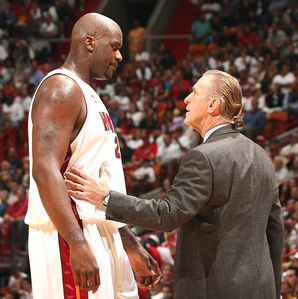
Whether you agree with the Heat’s move to acquire and sign Dwyane Wade, Chris Bosh, and LeBron James this off season are or not, one thing most of us can agree upon is that only a weathered and tested leader could handle the ego’s and attitudes of all three at the same time.  With the NBA basketball season quickly approaching, the following week’s inserts will focus directly on the man with the mission of delivering an NBA championship to Miami – Pat Riley.

everything basketball

What is your team-building leadership philosophy?

The overall philosophy is that you have to, voluntarily, get out of yourself and get with the program.  Whatever the program is.  You have to find a way to decide to either jump in or jump out. And getting yourself to that point first, instead of riding the fence philosophically, is first and foremost in trying to develop the confidence of the team. You’re either with me or against me. A house divided against itself surely will not stand. The most difficult thing any coach or teacher or parent ever has to do is to get someone to do the things they don’t want to do in order to achieve what the team needs. An that’s our challenge.

(Interview questions and answers taken directly from the February 2007 edition of Scholastic Coach & Athletic Director)


Topics: LeBron James, Pat Riley, discipline, Leadership

Would your athlete's choose you?

Posted by Boston Sports Medicine and Performance Group on Fri, Oct 1, 2010 @ 08:10 AM

everything basketball

The free market doesn’t exist in college athletics.  But let’s just say it did, just for a day.  When “your” athlete walks into your Athletic Training Room, or into your Strength and Conditioning Room and could choose from any member of your staff to help them, would they choose you?

What about the athlete from the rowing team? The Softball team? A male athlete? A female athlete? The freshmen athlete?

College athletes usually don’t have a choice, but if they did, would it be you?

Are you known as the “Football Guy” or the “Shoulder Girl” and those are the only athletes you work with or care about?

What does that say about your customer service?  Your willingness to listen to your athletes and patients? Your ability to follow up with them after an incredible training session or a devastating injury? Your ability to send an email, a text message or a simple word of encouragement?

What does it say about you if your designated athlete was able to choose their care and chose someone else on your staff…?

Would you choose you?


Art Horne is the Coordinator of Care and Strength & Conditioning Coach for the Men’s Basketball Team at Northeastern University, Boston MA.  He can be reached at a.horne@neu.edu.


Topics: Art Horne, basketball conference, athletic training conference, Strength & Conditioning, Leadership

It's never too early to panic

Posted by Boston Sports Medicine and Performance Group on Thu, Sep 30, 2010 @ 08:09 AM

everything basketball

It’s been 6 weeks since the date of injury and the athlete you’ve been working with is nowhere near ready to return to play. The coaching staff is breathing down your neck demanding answers and the rest of your staff is raising their eyebrows wondering what could have gone wrong.

Panic sets in….

Instead of panicking after it’s too late, try allowing panic to set in early.

Have a work-study student do a lit-review on the injury as soon as it happens, research the probable causes, latest rehabilitation techniques, running progressions, alternative therapies, and similar cases.

Better yet, let panic set in real early.

Prior to the date of injury, research and implement prevention strategies alongside your performance staff prior at the beginning of the season. Perform a meaningful orthopedic and movement screen with your athletes on the same day as your traditional pre-participation screenings to identify asymmetries and dysfunctional movement patterns with prescribed intervention to address these problems.

Let panic set in before there is anything to panic about.

Panic just like a duck. Calm above the water, and paddling like mad underneath.

Panic is good.

Panic keeps you a float and moving forward.


Art Horne is the Coordinator of Care and Strength & Conditioning Coach for the Men’s Basketball Team at Northeastern University, Boston MA. He can be reached at a.horne@neu.edu.

Topics: Art Horne, athletic training conference, boston hockey summit, Strength & Conditioning, Good to Great, customer service, development

It's About Time

Posted by Boston Sports Medicine and Performance Group on Wed, Sep 29, 2010 @ 07:09 AM

I have previously mentioned in this blog a team building event that we run for our student staff every year.  Though it is a lot of work, it is always a very rewarding experience for everyone involved and in particular the students.  Though some of our full-time staff are otherwise occupied and unable to volunteer, we do always have a good number of staff who are willing to give their time for a good cause.  One of the keys to the event of course is the formal invitation to student staff that goes out several weeks beforehand so that we can gauge attendance numbers for food, prizes, etc.  The collecting of student email addresses from their various supervisors on our full-time staff is always a challenge, but one staff member in particular has proven year after year to be “unable” to provide the email addresses of her students.  This year they emailed me five days prior to our event to apologize for not getting back to my inquiry until then and wondered if it would still be possible to include their staff.  I promptly returned their email, again requesting just the email addresses for their staff in whatever form was easiest for them.  The day before the event their response finally came and it said, “Dear Shaun, I just got time to get to this email.  This September has just been too overwhelming.  I truly appreciate the offer – maybe next year.”  Maybe next year?  Now, in all fairness, this person does have upwards of seven students working under them.   In the time that it took to send me two emails apologizing for being busy though, don’t you think they could have found the time to send me seven email addresses instead?

What’s our most valuable resource as employees?  Yup, you guessed it . . . time.  There’s an old saying that goes, “There are only so many hours in the day.”  That’s definitely true, but it’s not the time you spend at work or working that matter so much as what you do with those same hours.  That’s not to say that quantity is more important than quality (any medical professionals reading this?), but why take the time to send out a two page email to half of your colleagues when a simple phone call to one of them can clear up your issues in a fraction of the time?  Why have a meeting with ten people when you really only need three of them to resolve the issues at hand?  Are our assistants meant to perform the same tasks as us simultaneously or are they better suited to handle some tasks so that we can focus on others?  Think of it this way; if your company hired an independent consultant to come in and evaluate your work habits, would they report back that you were a model of efficiency or someone that would benefit from some additional training? 

A former colleague of mine recently posted or perhaps re-posted a tidbit that I found extremely interesting.  It said, “If you could only send 10 emails at work tomorrow, I bet those emails would really count for something.”  Working on cutting down on email vs. more personal contact (over the phone or in person) is just one area that we can focus on to improve our use of time.  This is a point that I harp on again and again, but just because you or your workplace has always done something one way does not mean there is not a more efficient way of doing it.  Take some time to evaluate your day to day tasks and ask that imaginary consultant on your shoulder if this is the best (time efficient and of high quality) way to do this. 

One of the larger problems however is that some of us look at a clock and see work time as the same whether we are being productive or not.  If you fall into that category, then my suggestion is even simpler . . . perhaps it’s time you looked at a new career.


Shaun Bossio is the Assistant Business Manager and ProShop Manager at Boston University FitRec. He can be reached at sbossio@bu.edu


Topics: Guest Author, Ownership, Good to Great, discipline, customer service, development, Leadership